
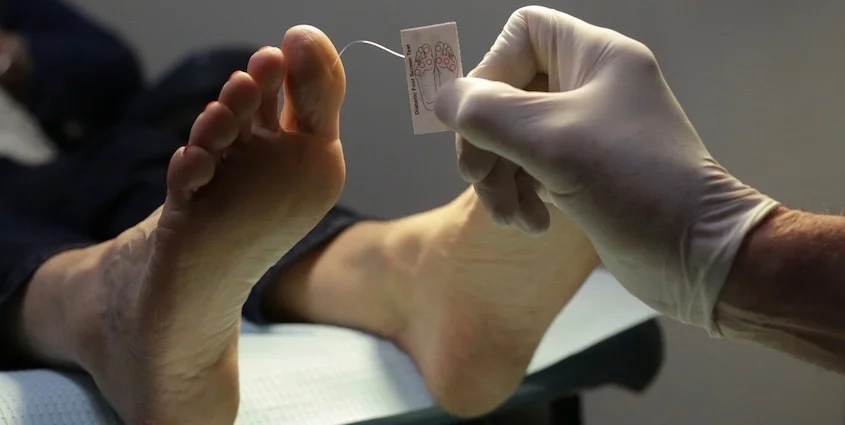
How does the monofilament test work?
Using the monofilament, you may screen your own feet or ask a relative, friend, or neighbor to do it for you.
To use the monofilament you:
1. Hold the monofilament by the paper handle.
2. Use a smooth motion to touch the filament to the skin on your foot. Touch the filament along the side of, not directly on, an ulcer, callus, or scar. Touch the filament to your skin for 1-2 seconds. Push hard enough to make the filament bend.
3. Touch the filament to both of your feet in the sites circled in the figures on the instruction card that came with the monofilament. Place a (+) in the circle if you can feel the filament at that site and a (-) if you cannot feel the filament at that site.
4. If another person is performing a monofilament test on you, it is advised that you have your eyes closed during the test and simply say “yes” every time you feel the 10-gram force from the monofilament on your foot.
How long do monofilaments last? Do they have an expiration date?
Our monofilaments have an expiration date of 2 years. All monofilaments are designed to be used within 24 months after fabrication, in accordance with FDA standards. All of our products are shipped with at least 22 months before expiration.
Are monofilaments reusable?
No. In accordance with FDA guidelines, our monofilaments are guaranteed to deliver a 10-gram force range for use in a single test. This means performing a screening for LOPS on one individual and then discarding the monofilament.
Is the monofilament latex-free?
Yes.
Are your monofilaments FDA approved?
Yes, all of our monofilaments have FDA clearance. More specifically Medical Monofilament Manufacturing has attained the 510(k) clearance for medical devices by the FDA.
How should monofilaments be stored?
Monofilaments can be adversely affected by time, extreme temperature, and high humidity, and should therefore be stored appropriately at room temperature in a dry environment.
What does a calibrated monofilament mean?
A calibrated monofilament means that the device has been tested and precisely provides the 10-gram force range as recommended. We calibrate our products daily using a gram scale, and our machinery later tests and records gram force range readings with precision inline sensors. Our manufacturing process also utilizes a high-tech visual inspection system that ensures we deliver the highest quality monofilaments available.
What does a 5.07 monofilament mean?
5.07 refers to the diameter of the monofilament fiber. The 5.07 monofilament has been accepted as the medical standard for screening for loss of protective sensation in the foot. At this diameter and at a precise length, the monofilament delivers 10 grams of force at flexion.
What is the monofilament made of?
Our monofilaments are made of a proprietary fiber that delivers 10 grams of force when bent to the point of flexion.

Frequently Asked Questions
What is a monofilament?
A monofilament is a single, uniform strand of polymer fiber used in clinical medicine as a sensory testing tool. In diabetic care, the 5.07 monofilament is the standard instrument for detecting loss of protective sensation (LOPS) in the feet. When pressed against the skin with enough force to bend the filament, it delivers a calibrated 10 gram (±1.5 g) touch stimulus. A patient who cannot feel that stimulus has lost protective sensation and is at significantly elevated risk for foot ulceration and amputation.
Why is the 10-gram / 5.07 threshold clinically significant?
Research has established that patients unable to detect a 10-gram force applied to the plantar surface of the foot have lost protective sensation, meaning they cannot feel injuries, pressure points, or heat. This threshold was validated across large clinical studies and is now the accepted standard in ADA, IWGDF and podiatric evidence-based clinical guidelines for identifying patients at high risk for diabetic foot complications.
Who should be screened with a monofilament?
All patients with diabetes should receive an annual foot sensory exam using a monofilament. Higher-risk patients, such as those with a history of foot ulcers, poor glycemic control, or peripheral artery disease, may warrant more frequent screening. The test is also commonly used in neurology, physical therapy, and any clinical setting assessing peripheral nerve function.
How does the monofilament test work?
Hold the monofilament by its handle and use a smooth motion to touch the filament to the skin on the patient's foot. Apply enough pressure to bend the filament for 1-2 seconds. The patient keeps their eyes closed and says "yes" when they feel contact. Mark (+) for felt sensation and (-) for no sensation at each of the four test sites on both feet. Inability to detect the filament at one or more sites indicates sensory loss at that location.
Which sites on the foot are tested?
Every Medical Monofilament product uses four test sites on each foot: the great toe (hallux) and the first, third and fifth metatarsal heads on the ball of the foot. The four sites are circled on the back of every handle and on the instruction card. Each site is tested independently, and results are recorded per site.
How long do monofilaments last?
Our monofilaments carry a 2-year shelf life from date of manufacture, per FDA standards. All products ship with at least 22 months remaining. Because each monofilament is a single-use device, the shelf life refers to storage life before first use, not duration of use.
Are monofilaments reusable?
No. Per FDA guidelines, monofilaments guarantee a 10-gram force range for use in a single test: one screening per device before disposal. Repeated use degrades the polymer fiber and causes the force delivered to drift below the 10-gram threshold, making the test unreliable.
What does "calibrated" mean?
A calibrated monofilament has been verified to deliver the recommended 10 gram force range, ±1.5 g, when bent to the point of flexion. Medical Monofilament calibrates production daily using gram scales and employs precision inline sensors and visual inspection systems throughout our automated manufacturing process, ensuring every unit that ships meets the clinical standard.
What is the monofilament made of?
Each monofilament is made from a proprietary polymer fiber engineered to deliver a 10 gram force range, ±1.5 g, when bent. The fiber diameter (5.07 on the Semmes-Weinstein scale) corresponds to the validated 10-gram force threshold. Our patented process controls fiber diameter and stiffness to tolerances that off-the-shelf materials cannot consistently achieve.
What does 5.07 monofilament mean?
5.07 refers to the Semmes-Weinstein log scale value corresponding to the filament's diameter. This diameter has been established as the medical standard for loss-of-protective-sensation (LOPS) screening in diabetic patients. The log scale value 5.07 translates to a 10-gram bending force, the critical clinical threshold.
Are your monofilaments FDA cleared?
Yes. Medical Monofilament has achieved 510(k) clearance from the FDA, the only monofilament manufacturer in the United States to hold this designation. 510(k) clearance means our device has been reviewed and found to be substantially equivalent to a predicate device in terms of safety and effectiveness. Many monofilaments sold in the U.S. have not undergone this review. Monofilaments are FDA Class I, single-use medical devices. Using each one only once also prevents cross-contamination between patients, in line with universal precautions.
Is the monofilament latex-free?
Yes. All Medical Monofilament products are latex-free.
How should monofilaments be stored?
Store at room temperature in a dry environment. Avoid prolonged exposure to extreme temperatures, direct sunlight, or high humidity, all of which can affect polymer stiffness and alter the force delivered during testing.
Can a patient self-test?
The monofilament test is designed to be administered by a clinician, with the patient keeping their eyes closed during testing. Self-testing is not recommended because the patient cannot reliably assess their own loss of sensation, the very deficit being screened for. Patients who cannot feel the test are often unaware of that loss, which is precisely why clinical screening matters.
What pack sizes do you offer?
We offer the 5.07 monofilament in 20-packs, 25-packs, and 40-packs, as well as individual Tyvek envelope units. Each product page includes pricing and details. Volume pricing and open purchase order programs are available for practices and distributors. Visit our Distributors page for more information.
Get in touch
Still have a question?
Our team responds quickly. Send us a message and we'll get back to you.
Contact Us